

Of course. Here is the rewritten and expanded blog post, crafted to be high-quality, in-depth, engaging, and perfectly formatted for WordPress.
***
“`html
AI Agents vs. Chatbots: The Real Difference in 2026
The year is 2026, and the frantic buzz that once surrounded generative AI has matured into a focused hum of enterprise adoption. The novelty of a machine that could write a sonnet or pass the bar exam has faded, replaced by a far more critical and pragmatic question that echoes in every boardroom: “What can it do for us?”
In the early 2020s, the world was captivated by conversational AI. Today, that fascination has given way to a paradigm shift driven by agentic AI—autonomous systems that don’t just talk, but act. This isn’t a simple upgrade; it’s a fundamental redefinition of how humans and machines collaborate to achieve complex goals.
Understanding the distinction between an AI chatbot and an AI agent is no longer a technical debate for developers. It is a strategic imperative for any business leader, marketer, or operations professional aiming to build a competitive advantage. This guide will move beyond the superficial definitions to explore the profound architectural, functional, and philosophical differences that separate a passive informant from a proactive digital colleague.
The Foundational Shift: From Intelligent Concierge to Autonomous Teammate
To truly grasp the magnitude of this evolution, we must define these technologies not by their conversational interfaces, but by their core purpose and capabilities in the context of 2026.
The AI Chatbot: A Brilliant, But Passive, Concierge
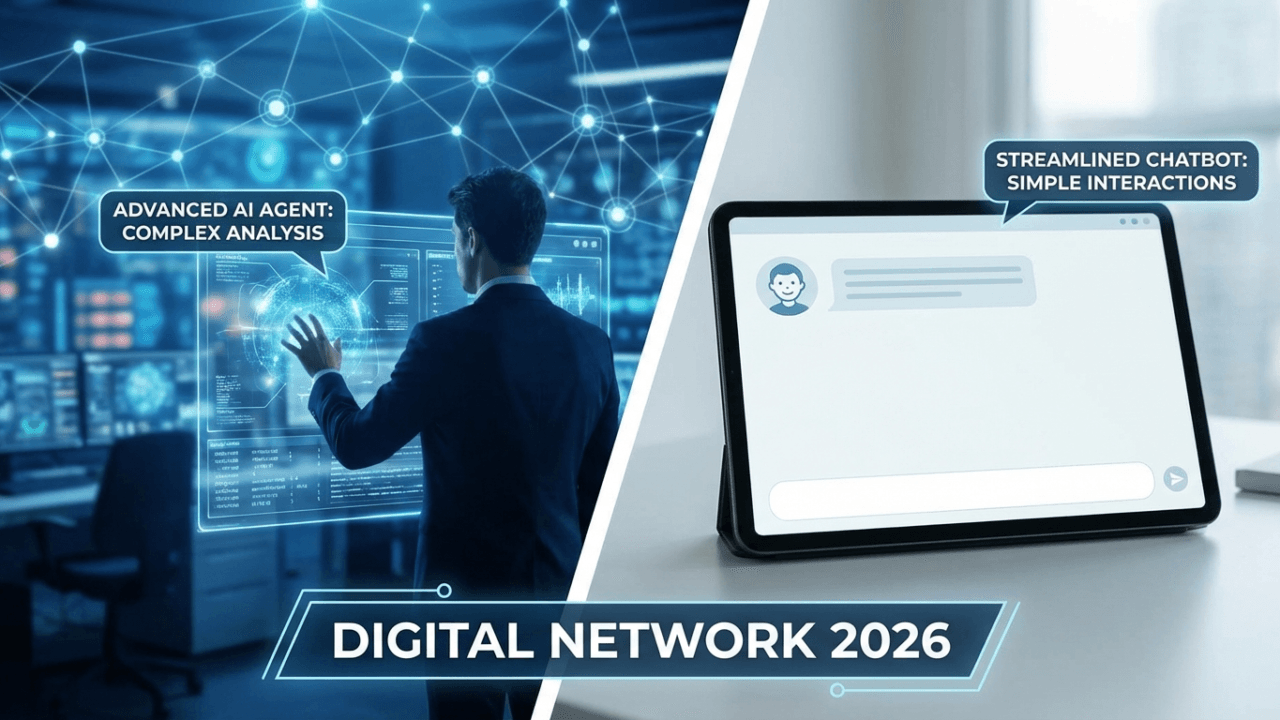
Think of a state-of-the-art chatbot, even one powered by the most advanced Large Language Model (LLM), as a hyper-intelligent digital concierge. It is a master of information, a brilliant librarian, and a patient customer service representative all rolled into one. However, its nature is fundamentally reactive.
- It waits for a human prompt.
- It processes the request against its vast knowledge base or connected data sources.
- It delivers a comprehensive, context-aware, and often multi-modal response.
In this dynamic, the human is the strategist, the project manager, and the sole initiator of action. The chatbot is a powerful tool for information retrieval and summarization—an encyclopedia that speaks. Its primary function is to inform.
The AI Agent: A Proactive and Goal-Oriented Teammate
An AI agent, in stark contrast, is a proactive, goal-oriented system. It functions less like a concierge you consult and more like a diligent, autonomous colleague you delegate to. You don’t give it step-by-step instructions; you assign it a high-level objective.
For example, instead of asking questions about a process, you give it a mission: “Onboard our new enterprise client, Acme Corp. Coordinate with their IT lead, provision their user accounts across our three platforms, schedule a kickoff call for next week, and generate a summary report for me once complete.”
The agent takes this objective and runs with it. It formulates a plan, identifies the necessary tools (APIs, software, calendars, email), and executes the multi-step workflow from start to finish. It doesn’t just answer questions about the onboarding process; it performs the process. The human acts as the executive, setting the strategic direction while the agent handles the complex tactical execution.
Under the Hood: The Architectural Chasm
The most profound difference between these two technologies lies deep within their cognitive architecture. While both may leverage the same foundational LLM for language understanding and generation, their operational frameworks are worlds apart.
Chatbots and the Linear Request-Response Loop
A chatbot operates on a simple, linear loop: Prompt → Process → Response.
This loop is fundamentally stateless. While modern chatbots use chat history to maintain conversational context, they lack a persistent “memory” or an internal model of a real-world task’s progress. Its job is self-contained within the interaction. Once the answer is provided, its work is done until the next query arrives.
AI Agents and the Iterative Reason-Act Loop
An AI agent operates on a far more sophisticated and cyclical framework, often called a Reasoning-Action Loop. This architecture is what grants it autonomy, allowing it to perceive its digital environment, formulate plans, and take action to achieve its goals. A typical agentic loop consists of several key stages:
1. Planning: The agent deconstructs the high-level goal into a sequence of smaller, actionable sub-tasks. (e.g., “Onboard client” becomes 1. Authenticate with CRM API. 2. Create new client record. 3. Query user provisioning API. 4. Loop through user list to create accounts. 5. Connect to calendar API to find open slots. 6. Draft and send meeting invite via email API.)
2. Tool Use & Execution: The agent selects and uses the appropriate “tool”—typically an API call—to perform a sub-task. It can interact with CRMs, marketing automation platforms, internal databases, and third-party software.
3. Observation & Verification: After taking an action, the agent observes the outcome. Did the API call return a success code? Did the new record appear in the CRM? This self-critique and verification step is critical for navigating errors and ensuring the plan is progressing correctly.
4. Reflection & Refinement: Based on the outcome, the agent updates its internal state and refines its plan. If a step failed, it can troubleshoot (e.g., try an alternative API endpoint) or report the specific error. If successful, it proceeds to the next sub-task until the primary objective is met.
This iterative process—combining long-term memory, strategic planning, and sophisticated tool use—is the engine of autonomy. It’s the difference between knowing and doing.
The Practical Divide: A Head-to-Head Comparison
These architectural differences create a vast gap in practical application. Here’s a clear breakdown of how they stack up:
| Feature | AI Chatbot (The Informer) | AI Agent (The Doer) |
|---|---|---|
| Primary Function | Information Retrieval & Conversational Interface | End-to-End Task & Workflow Execution |
| Interaction Model | Reactive (Pull): Waits for explicit user commands. | Proactive (Push): Acts autonomously on assigned goals. |
| Operational Scope | Largely confined to the chat window and connected knowledge bases. | Interacts with the entire digital ecosystem: APIs, databases, software, etc. |
| Cognitive Loop | Linear Request-Response | Cyclical Reason-Act-Verify Loop |
| Human Role | Micromanager / Operator | Strategic Director / Delegator |
| Example Prompt | “Summarize our sales performance for Q3.” | “Analyze our Q3 sales data, identify the top three underperforming regions, schedule individual performance reviews with the regional managers, and prepare a draft presentation outlining a recovery plan.” |
Agents in Action: The 2026 Business Landscape
Let’s move from theory to reality. Here’s how these technologies tackle common business challenges in 2026.
Scenario 1: Customer Support
- The Chatbot: A customer asks, “My order is late, where is it?” The chatbot accesses the shipping database and replies, “Your order is currently delayed at the regional distribution center.” The conversation ends, leaving the customer to wait or escalate.
- The AI Agent: A customer asks the same question. The agent identifies the customer and the order. It sees the delay, checks inventory at the nearest retail store, and proactively responds: “I see your order is delayed. To get it to you faster, I can have the same items dispatched from our downtown store for delivery in the next 2 hours, at no extra cost. Would you like me to proceed?”
Scenario 2: Supply Chain Management
- The Chatbot: A manager asks, “What’s the status of shipment #XYZ-789?” The chatbot replies, “Shipment #XYZ-789 is delayed by 48 hours due to a customs hold.” The manager now has to figure out the downstream impact.
- The AI Agent: The agent’s goal is to “ensure all shipments for Project Titan arrive on time and mitigate delays.” It constantly monitors shipments. When it detects the delay for #XYZ-789, it cross-references the production schedule, sees the delay will halt the assembly line, evaluates alternative freight options, and messages the manager: “Alert: Shipment #XYZ-789 is critically delayed. To prevent a production halt, I’ve secured an air freight alternative for an additional $4,500. This will ensure components arrive on schedule. Please approve within 60 minutes to confirm.”
The Future is a Collaboration, Not a Conversation
The distinction between AI agents and chatbots is not semantics; it’s the difference between a helpful tool and a transformative teammate. Chatbots augmented our ability to access information. AI agents are augmenting our ability to take action on that information, at a scale and speed previously unimaginable.
As we move through 2026 and beyond, the most successful organizations will be those that master the art of deploying, managing, and collaborating with these autonomous systems. The focus of human talent will elevate from performing repetitive digital tasks to designing complex workflows, setting strategic goals, and overseeing a workforce of highly efficient AI agents.
The true promise of artificial intelligence was never just about having a smarter conversation with a computer. It was always about empowering those computers to work alongside us—to tackle complex objectives, to automate intricate processes, and to free up human creativity for the challenges that matter most. The question for every leader today is no longer “How can we talk to our data?” but rather, “Are you building an information desk, or are you assembling a digital workforce?”