


I often think about how much medicine has changed in the last decade. It seems like every day, a new tech comes out, promising to solve big problems. It can be overwhelming to keep up with these changes.
The ai voice agent in healthcare is a big change I’ve seen. These tools are changing how we talk to medical systems.
With an artificial intelligence voice assistant, clinics can manage patient data fast. These systems do more than listen; they make clinical work faster. I think it’s important for patients and providers to know about these changes.
Key Takeaways
- Automated systems are changing how we talk to doctors.
- Clinical work gets faster with advanced speech tech.
- These tools help doctors do less paperwork.
- Patients get information and help faster.
- It’s key to understand these changes for modern medicine.
The Current Landscape of Voice Technology in Healthcare
Voice technology in healthcare is changing fast. It’s making healthcare better in many ways.
Conversational interfaces are becoming more common. They make talking to healthcare systems easier and more natural.
The Shift Toward Conversational Interfaces
Conversational interfaces are changing how patients talk to doctors. They use AI-powered voice solutions to help patients get medical info and make appointments. They even offer basic health advice through voice commands.
“The integration of voice technology in healthcare is not just about convenience; it’s about creating a more patient-centric care model.”
People want care that’s more efficient and personal. As voice tech gets better, we’ll see even more cool uses in healthcare.
Market Growth and Investment Trends in the United States
The voice tech market in healthcare is growing fast. It was worth billions in 2023 and will keep growing.
| Year | Market Size (USD Billion) | Growth Rate (%) |
|---|---|---|
| 2023 | 5.0 | 20 |
| 2024 | 6.0 | 22 |
| 2025 | 7.5 | 25 |
The U.S. is leading this growth. There’s a lot of money going into healthcare virtual assistants and AI-powered voice solutions. This trend will keep going as healthcare needs to get better.
As the market changes, healthcare providers need to keep up. They can use voice tech to make care better and work more efficiently.
Defining the AI Voice Agent in Healthcare
The use of AI voice agents in healthcare is changing how we care for patients. These systems can talk to people on the phone by themselves. They understand what callers need and do things on their own.
These systems help with many tasks, like setting up appointments and answering questions. They make healthcare better for everyone. It’s important to know what these systems can do and how they are different from simple chatbots.
Core Capabilities of Modern Voice Agents
Modern AI voice agents in healthcare have many important features. They can talk like people, making interactions better. They also work with health records, making it easy to get and update patient info.
- Natural Language Processing (NLP) for improved patient interaction
- Integration with EHR systems for real-time data access and updates
- Ability to perform tasks such as appointment scheduling and patient reminders
These features help doctors and nurses give better care. Patients are happier and get better results.
Distinguishing Between Basic Chatbots and Advanced Voice AI
Basic chatbots just give simple answers. But advanced voice AI, like AI voice agents, can have deeper talks. They understand the whole conversation and get better with time.
| Feature | Basic Chatbots | Advanced Voice AI |
|---|---|---|
| Interaction Complexity | Simple, predefined responses | Complex, context-aware conversations |
| Learning Capability | Limited or no learning | Continuous learning and improvement |
| Integration | Limited integration with backend systems | Seamless integration with EHRs and other healthcare systems |
Knowing the difference helps health groups choose the right AI voice agents. This choice can make their services better.
Key Drivers Behind the Adoption of Virtual Nurse Assistants
Virtual nurse assistants are becoming more popular. They help solve big problems in hospitals. They are a key solution for better patient care and saving money.
Addressing Staffing Shortages in Clinical Settings
Staffing shortages in hospitals are a big problem. Technology, like virtual nurse assistants, is helping. They help nurses by taking some of their work, so patients get better care faster.
Key statistics highlighting the nursing shortage include:
| Year | Nursing Shortage Rate | Projected Shortage |
|---|---|---|
| 2020 | 7.6% | 11% |
| 2025 | 10.3% | 15% |
| 2030 | 12.9% | 20% |
Improving Operational Efficiency in Hospitals
Hospitals want to work better. Virtual nurse assistants help by doing simple tasks. This makes hospital work flow smoother.
Reducing Administrative Burden on Nursing Staff
Virtual nurse assistants also help nurses. They do tasks like reminders and calls. This lets nurses spend more time with patients.
The benefits of virtual nurse assistants include:
- Enhanced patient engagement through timely reminders and follow-ups
- Improved operational efficiency by automating routine tasks
- Reduced administrative burden on nursing staff, allowing for more focused patient care
How Speech Recognition in Healthcare is Transforming Clinical Documentation
Speech recognition in healthcare is changing how we document patient info. It makes things faster and more accurate. This change helps doctors and nurses do less paperwork.
Moving Beyond Traditional Transcription Services
For a long time, we used old ways to write down patient info. These old methods were slow, expensive, and sometimes wrong. AI-powered voice solutions are now a better choice.
With speech recognition technology, doctors can speak patient info into EHRs. This cuts down the time spent on paperwork a lot.
Real-Time Data Entry During Patient Encounters
Being able to enter data right away is a big plus. It lets doctors spend more time with patients and less time typing.
Accuracy Improvements with Specialized Medical Lexicons
Thanks to specialized medical lexicons, speech recognition is much better. These special dictionaries help doctors’ words get written down right.
Let’s look at how speech recognition compares to old ways:
| Feature | Traditional Transcription | Speech Recognition Technology |
|---|---|---|
| Accuracy | Prone to human error | High accuracy with medical lexicons |
| Turnaround Time | Delayed, often hours or days | Real-time or near real-time |
| Cost | Higher due to manual labor | Lower operational costs |
Speech recognition in healthcare makes things better for everyone. It helps doctors focus more on patients and makes paperwork less of a hassle.
Enhancing Patient Engagement Through Voice-Enabled Healthcare Applications
Healthcare providers use voice technology to improve patient engagement. This leads to better health outcomes. Voice apps make it easier and more personal for patients to interact with healthcare services.
Personalized Medication Reminders and Adherence
Voice apps send personalized medication reminders. These reminders help patients take their medicine on time. AI voice agents call patients daily to check on their health and medicine.
Post-Discharge Monitoring and Follow-Up Care
Post-discharge care is key for recovery. Voice apps help monitor patients from afar. This quick action makes patients happier and reduces readmissions.
Improving Patient Satisfaction Scores
Voice apps boost patient satisfaction scores. They offer timely support and care. This makes patients have a better experience.
| Feature | Benefit | Outcome |
|---|---|---|
| Personalized Medication Reminders | Improved Medication Adherence | Better Health Outcomes |
| Post-Discharge Monitoring | Reduced Readmissions | Enhanced Patient Satisfaction |
| Follow-Up Care | Timely Intervention | Improved Quality of Life |
Voice apps are changing patient care by offering personal support. As healthcare grows, voice tech will be key in patient care and engagement.
The Role of Artificial Intelligence Voice Assistants in Triage and Scheduling
AI voice assistants are changing how we do triage and scheduling in healthcare. They make things more efficient. This helps patients get better care and makes things run smoother.
Automating Appointment Booking Systems
One big plus of using AI voice agents in healthcare is automating scheduling. Patients can book, change, or cancel appointments just by talking. This makes things easier for patients and cuts down on work for healthcare staff.
For example, a patient can call a healthcare place and ask to schedule an appointment. The AI voice assistant will handle it. It checks if doctors are free and confirms the appointment, all by itself.
Initial Symptom Assessment and Routing
AI voice assistants are also used for checking symptoms first. Patients tell the AI about their symptoms. Then, the AI decides how serious it is and where to send them for help.
Reducing Wait Times for Call Centers
Using AI voice assistants also cuts down wait times for call centers. They handle the first part of talking to patients. This means fewer calls for people to deal with. So, patients wait less and are happier.
| Feature | Benefit | Impact |
|---|---|---|
| Automated Appointment Scheduling | Reduces administrative tasks | Improves operational efficiency |
| Initial Symptom Assessment | Enhances patient routing | Ensures timely care |
| Reduced Call Center Wait Times | Decreases patient wait times | Improves patient satisfaction |
In short, adding artificial intelligence voice assistants to triage and scheduling is changing healthcare. They make booking appointments and checking symptoms easier. This helps patients, saves money, and makes things more efficient.
Security and Privacy Concerns in Voice-Controlled Healthcare Services
More people are using voice-controlled devices in healthcare. This makes keeping patient information safe very important. Healthcare groups must protect sensitive patient data well.
Using voice technology in healthcare brings new security and privacy issues. A big worry is unauthorized access to Protected Health Information (PHI). Keeping PHI safe is key for following rules like HIPAA and keeping patient trust.
Protecting Protected Health Information (PHI)
To keep PHI safe, healthcare providers need strong security steps. This includes:
- Checking that all voice devices and software follow HIPAA rules.
- Using end-to-end encryption for voice data.
- Doing regular security checks and risk assessments.
A study says keeping voice data safe is very important. Healthcare groups must act fast to avoid risks.
“Using voice tech in healthcare needs a strong security plan. This includes encrypting data, secure login, and always watching for threats.”
Mitigating Risks of Unauthorized Voice Data Access
To deal with risks of unauthorized voice data access, we need many steps. This includes:
- Creating strong login systems to make sure only the right people can see voice data.
- Using safe ways to store voice data that follow healthcare rules.
- Teaching staff about the importance of keeping voice data safe and how to handle it carefully.
| Security Measure | Description | Benefit |
|---|---|---|
| End-to-End Encryption | Encrypts voice data from start to finish. | Keeps data safe from being stolen or seen by the wrong people. |
| Regular Security Audits | Checks voice systems often to find weak spots. | Finds and fixes security problems early. |
| Secure Authentication | Makes sure only the right people can get to voice data and systems. | Stops wrong people from getting to private info. |
In short, dealing with security and privacy in voice-controlled healthcare is key. By focusing on keeping PHI safe and stopping unauthorized access, healthcare can be secure and private for patients.
Regulatory Hurdles for AI-Powered Voice Solutions
AI-powered voice solutions are changing healthcare a lot. But, they must go through many rules to work well. The rules help keep patients safe and trust the technology.
There are many rules for AI voice solutions in healthcare. These rules cover privacy, security, and medical devices. Following these rules is key to avoid trouble and keep patients safe.
Compliance with HIPAA and HITECH Standards
AI voice solutions must follow HIPAA and HITECH rules. These rules protect patient health information (PHI).
To follow HIPAA, AI voice solutions need strong security. This includes:
- Data encryption
- Secure authentication protocols
- Access controls
- Audit trails
The Office for Civil Rights (OCR) says AI voice solutions must protect PHI. Understanding these rules is very important for AI voice technology.
| Regulatory Requirement | Description | Implementation Example |
|---|---|---|
| Data Encryption | Protecting PHI during transmission and storage | Using TLS or SSL encryption protocols |
| Secure Authentication | Verifying user identity before granting access | Implementing multi-factor authentication |
| Access Controls | Limiting access to authorized personnel | Role-based access control systems |
Navigating FDA Approval for Diagnostic Voice Tools
AI voice solutions for diagnosis need FDA approval. The FDA checks software that acts like a medical device.
“The FDA’s regulatory approach to AI-powered medical devices is evolving to address the unique challenges posed by these technologies,” according to the FDA’s Digital Health Innovation Action Plan.
To get FDA approval, there are a few steps:
- Determine if the voice tool is a medical device
- Do detailed clinical studies
- Prepare a full submission (like 510(k) or PMA)
By knowing and meeting these rules, healthcare can use AI voice solutions well. This helps patients and keeps everyone safe and in line with the law.
The Impact of Voice Technology on Physician Burnout
Voice technology is changing how doctors talk to patients and Electronic Health Records (EHRs). It might help reduce doctor burnout. Doctors spend a lot of time writing down patient info, which can make them tired and unhappy. Voice tech makes it easier for doctors to write down patient data.
Streamlining Electronic Health Record (EHR) Interaction
Voice tech is helping doctors by making EHRs easier to use. Old EHR systems make doctors type a lot and look at screens. AI voice agents let doctors talk to write notes, update records, and find patient info. This makes things faster and feels more natural.
Using voice tech, doctors can do less paperwork. This saves time and makes their work easier. They can then focus more on helping patients.
Allowing Providers to Focus on Patient Interaction
Voice tech also helps doctors talk more with patients. By doing less paperwork, doctors can talk more with patients. This makes care better and patients happier.
The Shift from Screen-Time to Face-Time
Using voice tech means doctors look at patients more. They can see body language and talk better. This makes patients happier and helps doctors guess what’s wrong better.
| Benefits of Voice Technology | Description | Impact on Physician Burnout |
|---|---|---|
| Streamlined EHR Interaction | Voice commands for EHR updates and access | Reduced administrative burden |
| Enhanced Patient Interaction | Increased face-time with patients | Improved job satisfaction |
| Reduced Screen Time | Less time spent on typing and navigating EHRs | Decreased fatigue |

In short, voice tech is good for doctors. It makes EHRs easier and lets doctors talk more with patients. As more doctors use it, burnout will go down and care will get better.
Bridging the Accessibility Gap for Elderly and Disabled Patients
Voice technology is making healthcare easier for the elderly and disabled. These groups often struggle with tasks like scheduling appointments. This is because traditional interfaces like touchscreens can be hard to use.
Voice technology offers a simple way to interact. It’s great for those who find other interfaces hard. This includes people with limited mobility or vision.
Voice as a Primary Interface for Patients with Limited Mobility
For the elderly or those with physical disabilities, talking on the phone is best. Voice technology lets them do things like:
- Requesting medication refills
- Checking appointment schedules
- Accessing medical records
Using voice technology makes healthcare more accessible. It helps all patients manage their health needs.
Supporting Patients with Visual Impairments
Voice technology is also key for those with visual impairments. It offers audio interfaces. This way, patients can use healthcare systems without needing to see.
Here’s how voice technology compares to traditional interfaces for visually impaired patients:
| Feature | Traditional Interface | Voice-Enabled Interface |
|---|---|---|
| Accessibility | Limited for visually impaired | Highly accessible |
| Ease of Use | Requires visual interaction | Simple voice commands |
| Patient Engagement | May be challenging | Enhanced through conversational interface |
In conclusion, voice technology is changing healthcare for the better. It makes it easier for the elderly and disabled to get the care they need. As healthcare evolves, voice technology will be more important than ever.
Real-World Case Studies of Successful Implementations
AI voice agents in healthcare have shown great results in many studies. They make things run smoother and help patients more.
Looking at how early users did helps us learn. It shows us the best ways and what might go wrong.
Lessons Learned from Early Adopter Health Systems
Health systems that started early with AI voice agents have seen big wins. They have fewer missed appointments. Front desk teams can spend more time with patients.
A study found, “AI voice agents make things run better. Doctors can spend more time with patients.”
“The use of AI voice agents has revolutionized our appointment scheduling process, reducing no-shows and improving overall patient engagement.”
These stories show how key it is to plan well and keep checking how things go. This way, AI voice agents can really help.
Measuring Success Through Clinical Outcomes
Success with AI voice agents means looking at how they help patients and doctors. We check if patients are happier, if things run smoother, and if care is better.
By looking at these results, places can make AI voice agents even better. This helps patients and makes things run better too.
AI voice agents in healthcare are always getting better. There’s always new research and ideas to make them even more useful.
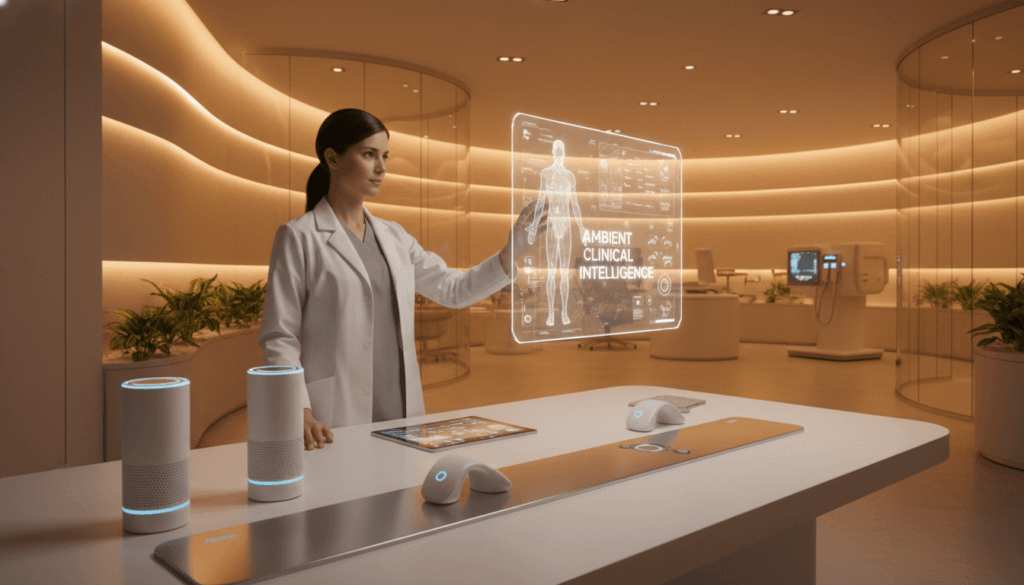
The Future of Ambient Clinical Intelligence
The world of healthcare is changing fast. Ambient clinical intelligence is leading this change. It’s making patient care better and making work easier for doctors and nurses.
New systems are coming that will fit right into hospitals. They will work together smoothly, like one big helper. This will make doctors and nurses work better and faster.
Advancements in Passive Listening Systems
Passive listening systems are a big step forward. They listen to conversations without needing anyone to press a button. This makes doctors’ work easier.
These systems use smart tech to understand what’s being said. They make sure important details are recorded. This helps doctors make better decisions.
Predictive Analytics and Proactive Care
Predictive analytics are key to the future. They help doctors prevent problems before they start. This is thanks to advanced tech that looks at lots of data.
| Feature | Current State | Future State |
|---|---|---|
| Data Analysis | Retrospective analysis | Real-time predictive analytics |
| Clinical Decision Support | Limited integration with EHRs | Seamless integration with EHRs and clinical workflows |
| Patient Engagement | Reactive patient engagement | Proactive patient engagement through personalized care plans |
The future of healthcare looks bright. With better systems, we can help patients more and make care better. It’s all about working together and using smart tech.
Ethical Considerations in Automated Patient Communication
AI voice agents are changing healthcare. They help with patient care, but we must think about the ethics. It’s important to make sure these technologies help, not harm.
Experts say AI should help, not replace, human care. This means we need to balance tech and human touch in healthcare.
Maintaining the Human Touch in Care Delivery
Keeping the human touch is key. AI can do routine tasks, but we must keep care personal and empathetic.
Healthcare can use AI and humans together. AI can do initial checks, so humans can focus on deeper care.
| Task Category | AI Voice Agent Role | Human Caregiver Role |
|---|---|---|
| Initial Assessment | Conduct preliminary symptom checks and gather patient data | Review AI findings, provide diagnosis, and develop care plans |
| Routine Tasks | Manage medication reminders, appointment scheduling | Focus on complex care needs, provide emotional support |
| Patient Monitoring | Continuously monitor patient conditions, alerting staff to changes | Respond to alerts, adjust care plans as necessary |
Addressing Algorithmic Bias in Voice Recognition
AI voice systems can be unfair if biased. This can hurt certain patients, making care worse.
Developers must use diverse data to train AI. This means using many voices and languages to help everyone.
As Dr. Jane Smith, a leading researcher in AI ethics, notes, “The diversity of training data is crucial for preventing biases in AI systems.” Ensuring that AI voice agents are trained on diverse datasets is a key step toward providing equitable care.
Here are ways to fight bias in AI:
- Use diverse data for training AI.
- Check AI for bias often.
- Let patients and staff report issues.
By tackling these issues, we can use AI for good. This way, we keep care caring and compassionate.
Conclusion
AI voice agents are changing healthcare a lot. They help patients and doctors work better together. This makes care better for everyone.
AI voice agents are not just new; they’re key to healthcare now. They make talking to patients easier and help doctors focus on what matters most. We’ll see even more cool uses of voice tech in healthcare soon.
The future of healthcare looks bright with AI voice agents. As they get better, they’ll make healthcare even more effective. This will help both patients and doctors a lot.